
Should a Bookseller own a Kindle? Pros & Cons
As a bookseller, should I own a Kindle?
To start, I bought a Kindle years before I started selling books. I remember carrying a rucksack packed with books onto a plane for a beach holiday. It was far too heavy and completely impractical.
Not to mention the few times I have dropped paperbacks into the bath.
The Kindle solved these problems overnight, it was lightweight, waterproof, and, most of all, convenient. But now that I sell physical books, I wonder whether using a Kindle makes me a hypocrite.
Let's begin with a list of pros and cons.
Pros
Instant Books
Lightweight
Waterproof
Adjust Text Size
Built-In Light
Long Battery Life
Cons
Not a Physical Book
No Colour Images
Upfront Cost
Owned By Amazon
Amazon
It’s all about Amazon.
Amazon is the largest bookseller in the world. They dominate the eBook market with Kindles. Not to mention that the company has faced criticism over its tax practices, worker rights, impact on the environment, and all-round business ethics.
I did, however, find some good reports about Amazon. First, they do get more books into the hands of readers. The same goes for large shops like Waterstones (Barnes and Noble). These big companies have enabled mass literacy that otherwise wasn’t available in the 80s and 90s. In addition, they do provide a platform for independent writers.
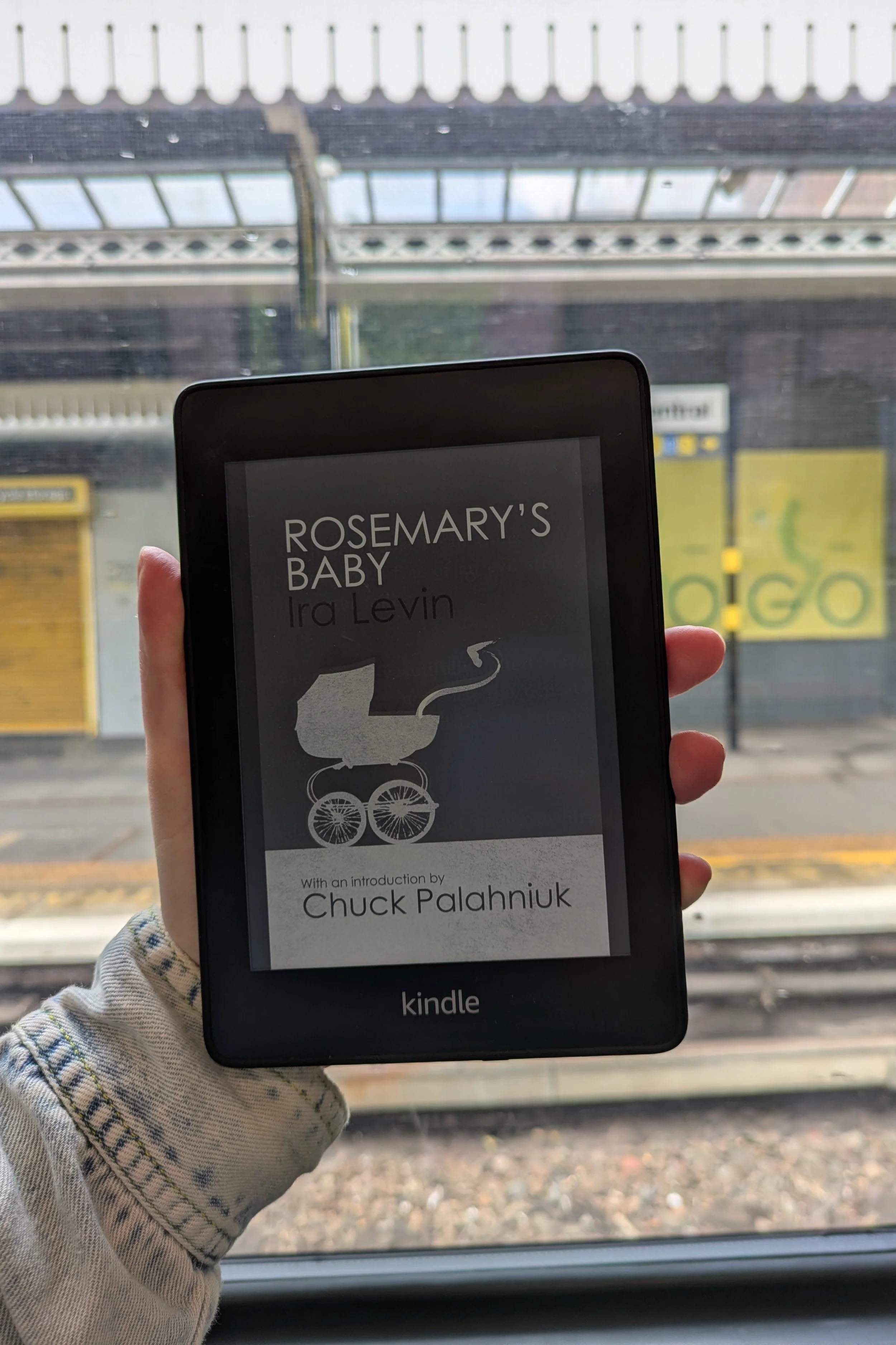
Should Booksellers own a Kindle?
Still, Amazon is bad for bookshops.
Amazon's growth has coincided with the decline of the high street. It’s estimated that 50% of bookshops have closed since 1995, as well as 50% of the overall high street. Anything from hardware shops, video rentals, toys and electronics shops has all closed due to Amazon's growth.
The Colossal Conglomerate also owns over a hundred companies worldwide. Unfortunately, for book sellers, this includes AbeBooks, one of the biggest retailers of second-hand and rare books. So, even if you tried, you can’t avoid buying from Amazon.
Bookshops
It’s not all bad news. We talk about the bookshops closing, but in the UK more independent bookshops opened last year than closed. People still buy from bookshops and some booksellers are doing very well financially (personal experience).
Most of all, bookshops win for customer service, rare books and being environmentally friendly. At an independent bookshop, you can request books for delivery and have the owners help you find books. When it comes to rare books, you can trust an experienced bookseller rather than a faceless company.
Bookshops also offer the element of surprise and discovery. In general, second-hand book shops allow you to try out new writers for a lower cost. Not to mention the atmosphere and good karma from supporting a local business.
Pros
Lower Costs
Eco-Friendly
Unique Books
Rare Finds
Atmosphere
In-Person Service
Convenience
It’s all about convenience.
You can boycott Amazon, but they have already won.
Booksellers need to focus on what Amazon can not do. Such as providing personal service and building relationships with buyers and customers. Plus, the role of an eco-friendly option for the local community.
Amazon can not talk directly to customers, they can not find rare books or offer anything tailor made, including rare quality items and a premium service.
However, I do believe bookshops need to make buying from them more convenient. For example, I visited a bookshop recently that was an hour journey away. Google said they were open, but when I arrived they were closed. Many second-hand shops I've visited don’t have clear organisation by genre and topic. Pricing is also messy and unclear.
So, in my opinion, some bookshops need to make their business more accessible and convenient for the modern customer.
How can independent bookshops compete with Amazon?
· Organised shelves
· Clear pricing
· Take Card & Cash
· Bulk buy deals
· Face-out displays
· Loyalty stamps
· Online Stock Lists
· Up to Date Socials
Should I own a Kindle?
I bought two books this year on my Kindle, both for a book club. I wasn’t able to find these titles in a second-hand shop, and there was no guarantee at Waterstones. So, Kindle was the fast, convenient option, plus the books were on sale for £1.00 each.
I am in two minds, as someone who buys physical books weekly. As much as I dislike Amazon’s ethics, I do believe I can still keep my Kindle for those convenient moments.
As for my online bookshop, I provide a more personal, eco-friendly service, and I sell unique vintage books, some of which you can't find anywhere else online.
I feel that the damage is done.
There should have been rules for these large companies to avoid a monopoly, and there should have been more done to protect the local high street.
For now, bookshops need to forget about Amazon and focus on what they can control.
Roman Numerals for Booksellers
I’m embarrassed to admit that I don’t know my Roman numerals.
In my short bookselling career, I've come across plenty of dates and usually end up checking them on my phone. Maybe you know XI, but what about MMXXVI?
Booksellers need to understand Roman numerals when identifying the dates on antiquarian books. This is a short guide with a free cheat sheet below.
Roman Numerals
Booksellers commonly encounter Roman numerals on title pages, copyright pages, and in signatures when collating antiquarian books. Being able to recognise them quickly makes cataloguing and identifying editions much easier.
In addition, many publishers continued to print publication dates in Roman numerals, especially on limited editions and folios.
Roman numerals are formed by combining seven letters: I (1), V (5), X (10), L (50), C (100), D (500), and M (1000). Most numbers are written from largest to smallest, with a few exceptions that use subtraction, such as IV (4) and IX (9).
For example, 2026 is written as MMXXVI.
Subtraction Rule
In standard Roman numerals, numbers are read from left to right. When a smaller numeral appears before a larger one, you subtract its value from the larger one.
The Roman numeral for four is IV. Some clocks and monuments use IIII. The IV format is a subtraction (5 minus 1), making the number shorter and easier to read. You also use subtraction when writing the number nine, IX (10 minus 1).
1 - I
2 - II
3 - III
4 - IV
5 - V
6 - VI
7 - VII
8 – VIII
9 - IX
10 - X
Examples
XIV = 14
XVII = 17
XXIX = 29
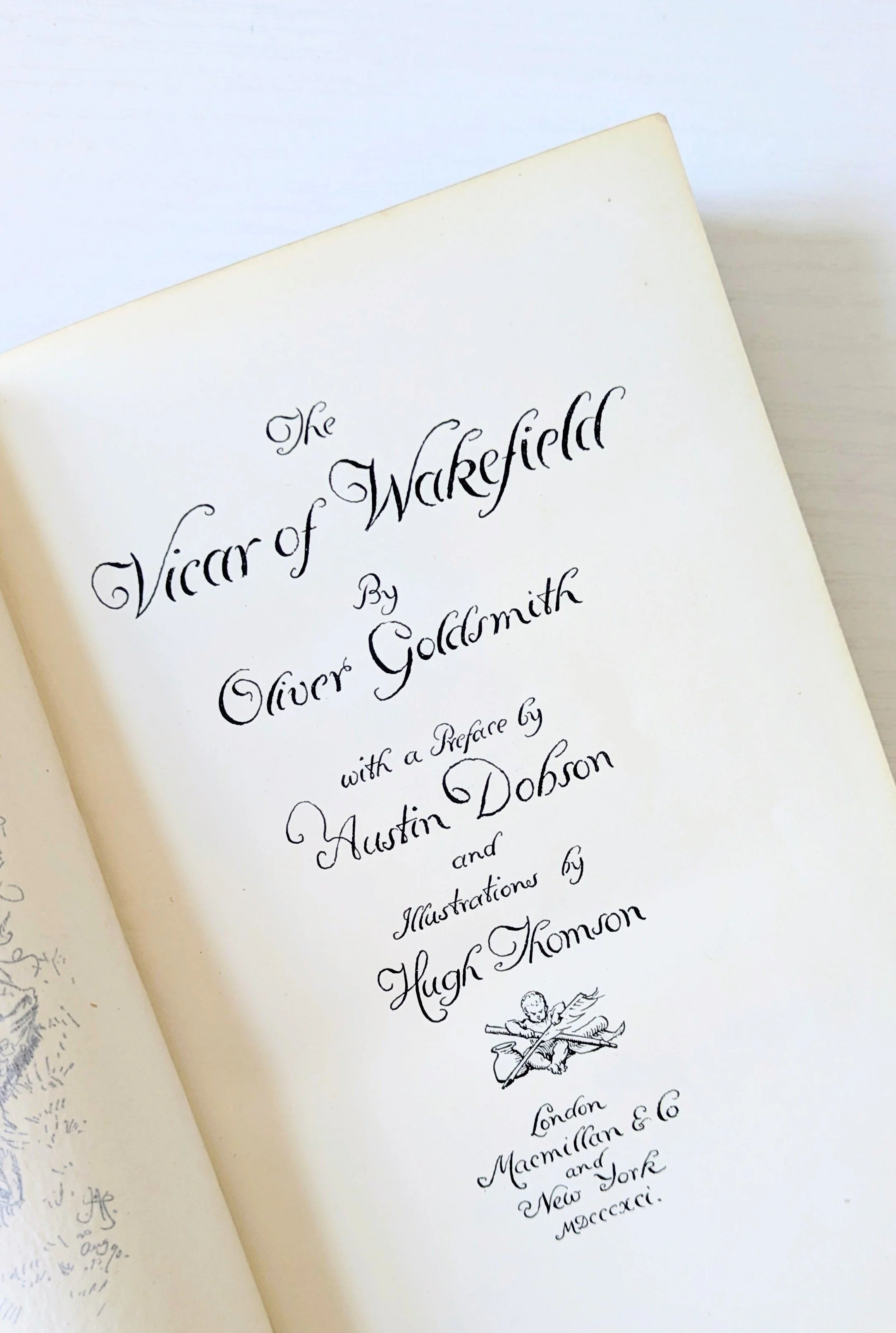
MDCCCXCI = 1891
Larger Numbers
The number 50 is written as L, and the subtraction rule applies to 40, written as XL. Similarly, 100 is written as C, and 90 is written as XC.
Another letter to remember is D for 500. So, the number 600 is written as DC. Lastly, we have 1000 represented by M.
10 – X
20 – XX
30 – XXX
40 – XL
50 – L
60 – LX
70 – LXX
80 – LXXX
90 – XC
100 – C
200 – CC
300 – CCC
400 – CD
500 – D
600 – DC
700 – DCC
800 – DCCC
900 – CM
1000 – M
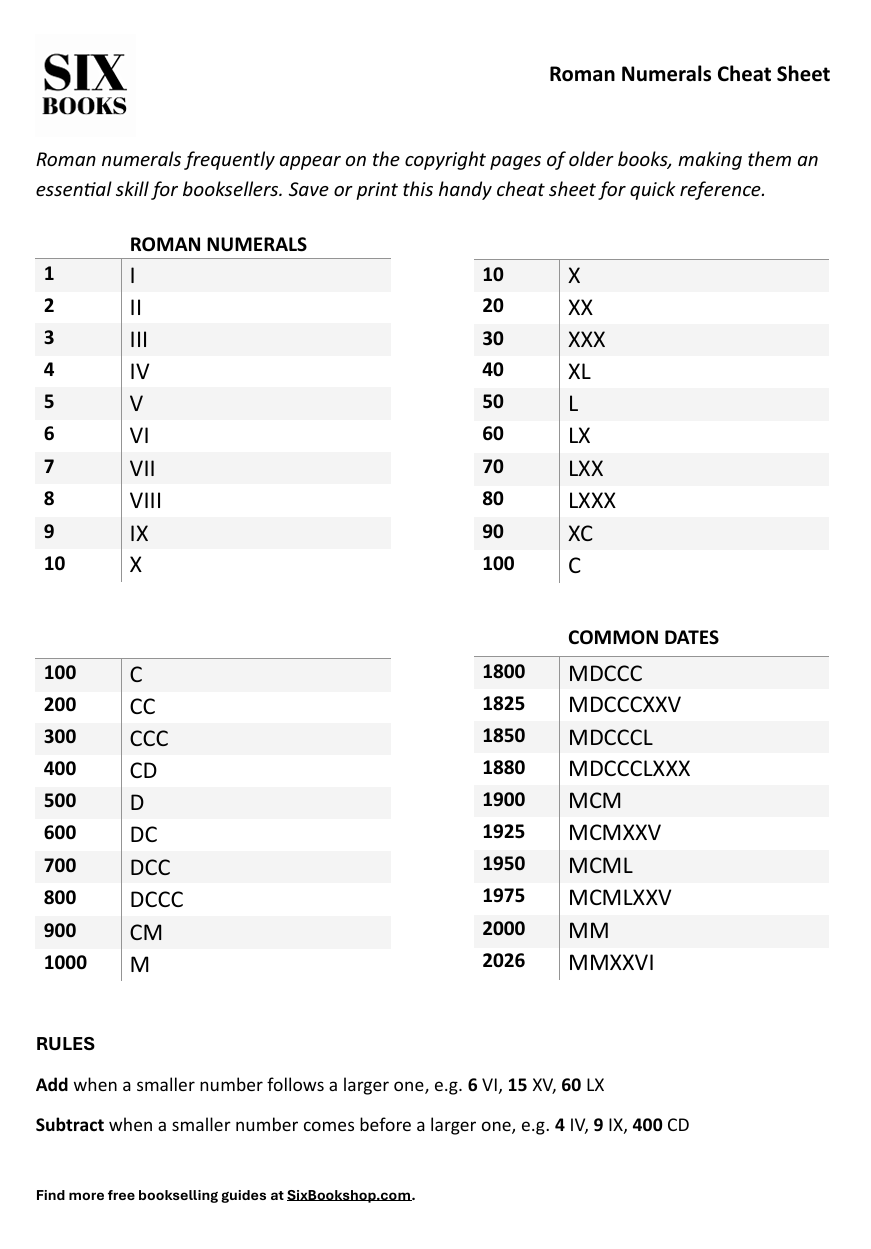
Download Below
Epilogue
Even after researching Roman numerals, I’m still struggling. It looks like I'll still need to keep revising before Roman numerals become second nature.
So, how did you do? How confident are you with your Roman numerals? Let me know below so I know I’m not alone.
Day in my Life - as a Rare Book Seller
I’ve been a rare book seller for a few months.
No two days are the same. I might spend a whole day buying books, the next researching and another taking photographs for my website shop.
Although a variety of tasks does make the day more interesting.
For reference, I am working at least 40 hours a week. However, the day below is very idealistic. To begin, I make a list of tasks on an app called To Do List. Starting with the most important and ticking them off.
Not every day as a rare book seller is productive. But by the end of the week, I will complete most of my tasks.
If you have any insights into your own workday, let me know in the comments.
9:00 am
I wake up and press snooze. If it weren’t for my need to pee, I would stay in bed all day.
I’m British, so I start the day with a cup of tea. I check my emails, social media and make a list of daily tasks. I only get dressed in the morning if I am leaving the house.
First task, Instagram stories and a post if I have one ready to go. I have recently started to experiment with short video reels.
11:00 am
As a rare book seller, I have my eye on items at an online auction. I predict my books will sell at eleven, but there is a delay. While I wait, I pack books ready for the post office.
Last night I made two sales on my eBay shop and one on my website. Packing books is my least favourite task. It takes too long, and the printer doesn’t always like me.
It’s my chance to bid at the auction. But there’s too much competition, and people bid more than the books are worth.
1:00 pm
I walk to the post office, and it’s busy. I remind myself that it’s easier to post at the end of the day. I’m trying to walk more, so I head to the supermarket for some basic supplies before walking to my nearest second-hand bookshop.
I am lucky to live in Liverpool as a rare book seller. Although I have heard other booksellers complain about the lack of opportunities here. I have found that there are opportunities if you look for them.
I’ve made friends with all the local booksellers and keep an eye out for book-related events. I believe that any city will have just as many opportunities.
In the bookshop, I bought three books, perfect for my website shop.

Andrew Lang, Excellent Condition
4:00 pm
When I get home, I change into comfy clothes. I have a home office, but I prefer the comfort of the couch. While watching Bob’s Burgers, I draft a blog post.
My last job was as a content writer. It’s good to know I can use the skills I’ve gained to support my new rare bookselling business.
I have plenty of plans to grow my website and make it profitable. Watch this space!
6:00 pm
If it were winter, the low light would make me want to finish work by now. But the long days keep me active. I decide to prep some books for eBay. Yesterday, I drafted the text for a handful of books. Now I need to take detailed photographs.
In the backroom, I have a foldable table and a lightbox. The space makes it easy to take photographs and check the books for faults.
I edit the photographs on Adobe Express and upload them to the eBay app. For basic eBay listings, I can do all of this on my phone.
8:00 pm
On a typical evening, I eat dinner with my boyfriend, watch TV and scroll on my phone. I might read a book or watch a film. Although there is so much work left to do, I often find myself completing basic tasks, such as emails and social media.
I have Excel files, business plans, and I keep a close eye on my income and outgoings. But it has become clear that life is becoming too expensive. I’m confused about how much income and savings I really need to live and maybe retire.
Recently, I have been racking my brain for ideas. Luckily, I have had a few good ideas, but it will still take a while to get going. I fall asleep anytime between 11pm and 2am.
I hope this post has shared some insight into the life of a rare book seller. As mentioned, I am still new to this trade. If you have any tips, let me know below @sixbookshop.
Chester Bookshops Book Buying Guide 2026
I spent a day exploring Chester bookshops.
Chester is a picturesque Roman city just an hour by train from Liverpool. It features quaint bookshops with both antiquarian and modern titles.
It’s also a beautiful place to find unique books and capture aesthetic photographs. I recommend it for history and book enthusiasts. Plus, it’s a great location for videos and Instagram content.
Below, I will list Chester bookshops that are open as of May 2026.
Second-hand Bookshops
To begin with, I source rare books through a range of methods. However, the easiest and most satisfying way is by visiting bookshops. I like to challenge myself to find a rare book in every bookshop I enter. In Chester, I successfully found a range of unique botanical and wildflower books which I am selling on my website shop.
Let’s look at Chester bookshops, plus I will share some book hunting tips.
Aldous Books
Aldous Books Chester Closed 28/06/2026
Gina and Steve have two bookshops. One Liverpool bookshop and a small shop hidden away by Chester Cathedral. Chester is a boutique shop focused on local history.
In addition, they have a section for natural history books. Whenever I visit a bookshop, I quickly browse every section before taking a closer look. In Aldous, I found an encyclopaedia of natural history, plus an illustrated vintage book on Trees.
Amblongus Books
Sally sells children’s collectable books and specialist books in a range of themes such as religion and art. You can find Amblongus at the far end of Chester High Street.
Inside, the bookshop feels organised and relaxed. I make sure to check the quality of every book I buy. Is the spine strong? Does the book have visual appeal? In Amblongus, I bought several ornithology books, plus some vintage natural history.

Amblongus Books, Chester
Bookingham Palace
Ritchie runs the combined vinyl and book shop. You can find everything here, from folios and poetry to religion and new editions. The books are all in excellent condition and priced better than those at larger chain bookshops.
I always have my eye on the natural history books. There is a large bookshelf at the back of the shop with a range of wildlife titles. I make sure to check the inside of every book for plates and condition. In Buckingham Palace, I bought a nature-themed poetry book and Penguin Vintage paperbacks.
New Bookshops
As a bookseller, I don’t sell new books, instead focusing on vintage titles. However, as a reader I occasionally treat myself to lovely editions for my personal collection. The bookshops below are all independently owned and specialise in new books.
Books on the Walls
Kate’s shop is a great place to enjoy a slice of cake while reading a book. You can find a little bookshop hidden on the upper walls at the far side of Chester High Street. Inside, they sell new fiction, cake and literature-themed cocktails.
I felt very welcome when entering the shop. If I wasn’t on a bookshop tour, I could have stayed. At books on the walls, I bought a luxury copy of Mrs Dalloway. In addition to a few natural history-themed poetry zines.

Books on the Walls, Chester
Chapters
Chapters is a bookshop and wine bar in the city centre run by two Megan’s. Unfortunately, during my latest trip to Chester, I ran out of time to visit. But next time I head over, I'll probably finish my book crawl with a glass of Pinot.
Final Thoughts
I hope this blog post has helped you understand how to plan a book day in Chester. As mentioned, the city is an hour train ride from Liverpool. I hope to travel to more UK cities this year and see what they have to offer booksellers and book buyers.
Instagram @sixbookshop
How I Source Books for My Rare Book Business
To run my rare book business, I need to source stock regularly and consistently.
I am in the early days of my business, but I still sell 50 books a month on my website, at local markets and on eBay. I find these books from a mix of sources.
Below, I’ll outline the main ways I source books for my rare book business, from easiest to most complicated.
How I find books for my rare book business
Bookshops
Online
Markets
Donations
House Calls
Auctions
1. Bookshops
The first place I look for rare books is second-hand bookshops. When I first started book hunting, I struggled to find rare books. But with practice I’m developing a stronger eye. I have a rule to always buy a book when I visit an independent bookshop. Both to support bookshops and to challenge myself to find unique items.
With practice, I have already memorised a ton of books, their covers and what to look out for with first editions. Although even when I find a great book, there is no guarantee that it will sell for profit or quickly enough. I still have a lot to learn about rare book selling.
The main drawback with buying from bookshops is that prices are often high. They are also not a practical option if you need to build up a large amount of stock.
Pros
Easy way to start looking for rare books
Great for supporting bookshops
Cons
No guarantee that you will find rare books
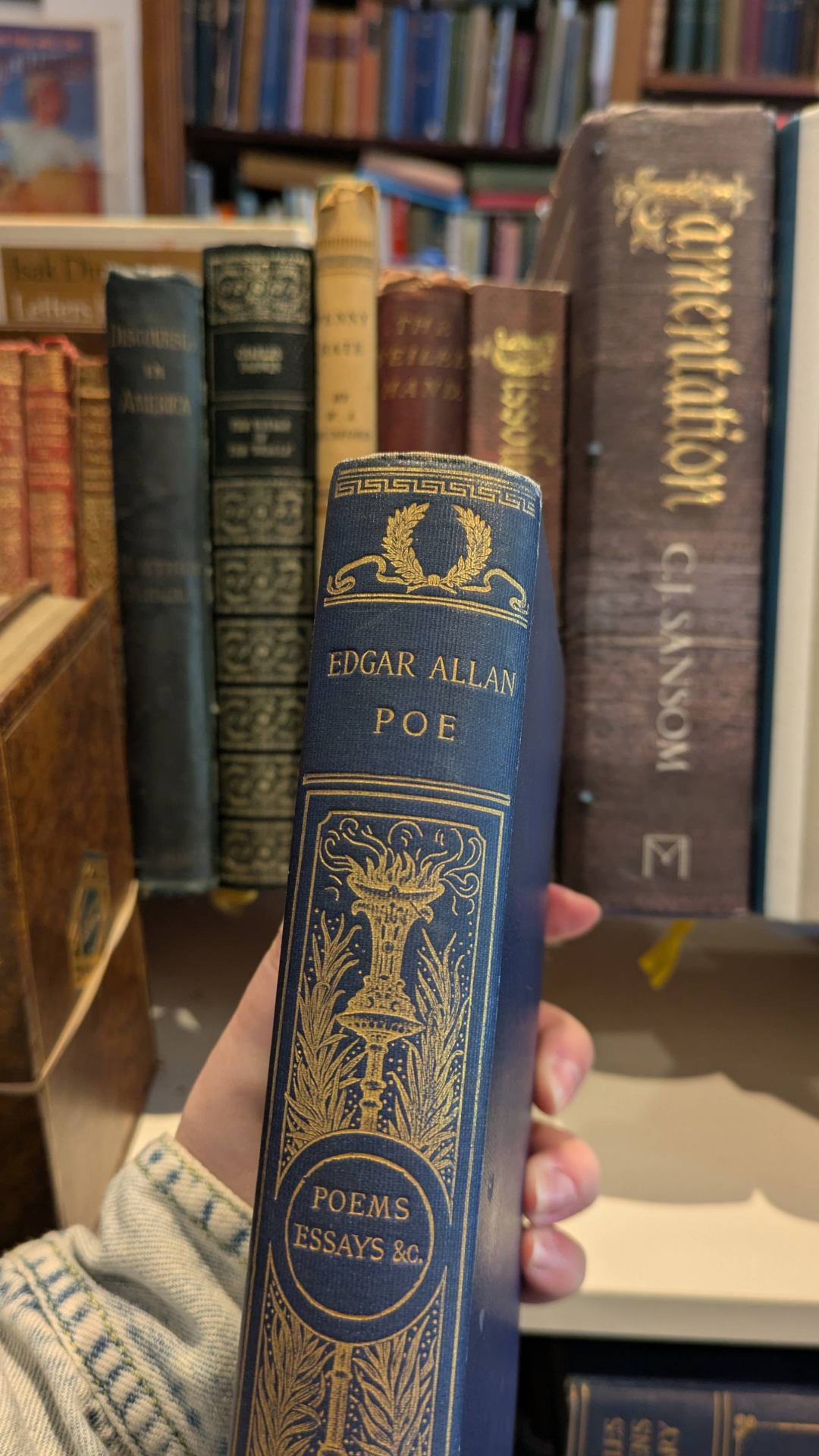
Bookshop Hunting
2. Online
Yes, you can find rare and vintage books on online marketplaces such as my eBay shop, AbeBooks and Facebook Marketplace. This is especially useful when you know exactly what you’re looking for.
Still, good deals are hard to come by, and many books are priced too high for resale. I have had some luck with buying job lots on eBay. You can also save searches, for example ‘vintage books’.
Pros
Easy way to find and buy books
Cons
Hard to find rare or distinctive books
3. Markets
Markets, specifically book markets, are a great place to find rare books. By attending them, you can find deals, unique books, and stock up. You do need to know what you are looking for and have an understanding of book prices.
Most of all, markets are good for finding a few good deals. But they are not great for getting hold of a large amount of stock. You can find UK book markets on the PBFA website, although I have also found great books at local non-union markets.
Pros
Good for finding quality rare books
Cons
Requires a good understanding of book values
Competitive with other book sellers
4. Donations
As soon as I said I was selling books, people started to donate. The same will happen if you open up a bookshop. People will donate books by the bag load to book sellers.
However, that doesn’t guarantee that the books are any good. I’m very picky and have learned that not all books sell. The best job lots I have got are from other booksellers who have surplus stock. The worst, members of the public with bags of paperbacks.
At the start of my bookselling career, donations were great for building up my knowledge. However, it’s unlikely I will receive another worthwhile donation.
Pros
Free job lots of books
Cons
Less likely to find rare books
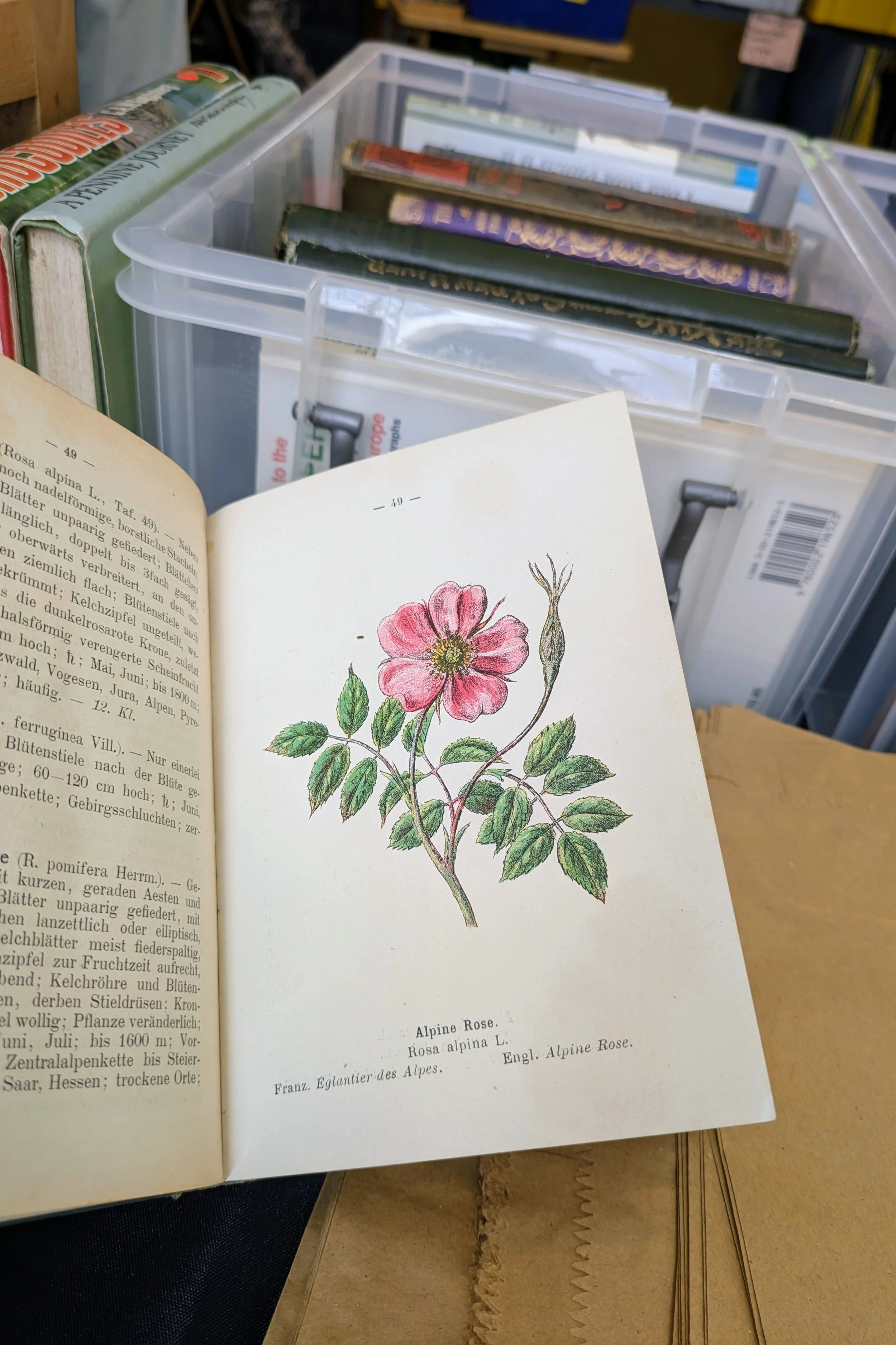
Exploring Book Markets
5. House Calls
House calls are when people invite you to go into their home to buy from their library. This happens either when people want to downsize, or the owner of the books has passed away.
I don’t do many house calls, mainly because I don’t have a car (or license). I am also aware that entering someone’s house as a woman is potentially dangerous. The ones I have done have been with people I know.
House calls are difficult to find, especially from people with valuable libraries. You need to build trust and establish yourself in the bookselling business. Although when you get one, they are a great way to build stock and find rare book deals.
Pros
Great way to build book stock
Cons
Hard to find worthwhile invites
6. Auctions
I have made my highest profits buying from auctions, I have also lost the most money. Auction sites such as saleroom have hundreds of rare items every week.
However, auctions are highly competitive. You’re not just bidding against the public, but also against other booksellers, many with deep pockets.
Even if I research, plan and budget for an auction to perfection, there is no guarantee you will make a profit. My best sale was a £300 book which I later sold for £1500. My worst was a £500 book for £200.
Auctions are an expensive risk. Every sale you make has an addition 20 -30% put on top by the auction house. Postage and shipping costs are also high. For reference, I paid £40 to post one book from London to Liverpool.
Pros
Great for finding rare and unique stock
Cons
Very expensive with additional costs
Highly competitive bidding
Final Thoughts
There are lots of places to find books for a rare book business. Although each has pros and cons, the best way to buy stock is to use a mix of sources. For instance, I make sure to go outside to bookshops and markets every month. Then I keep an eye on auction listings for a good deal.
Thanks for reading. I am still a new bookseller, so if you have any tips on buying and selling books, let me know below.
What I Learned My First Month in Business
Let’s recap.
May 2026 was the first month I treated Sixbookshop as a full-time business. After two years of selling books at markets and on eBay, I wanted to see whether I could turn bookselling into a career.
Below, I will break down my first month in business, what I learned, and I hope this transparent approach will help others.
Business Plan
First, I just want to say, don’t you think my website looks great?
I kept everything minimalist, and I take all photographs myself. I hope a more personal approach will show that I’m a real person.
My eBay shop still makes most of my sales. So I have no plans to stop selling there. The website shop is more of a ‘boutique’ collection of books. I’m very happy and surprised that I have already had sales from my website shop.
After asking other online book sellers for tips, my plan is to post daily on my Instagram. I am also building an email list and uploading books consistently throughout the week.
Profits
Sixbookshop is a business, so I need to make a monthly profit.
The problem is that when people are transparent about their business income online, they always leave out the details. You don’t know if they have large savings, have paid off their mortgage or have a partner that supports them.
So, read profit reports with caution. I’m not going to get too transparent with my income as I believe it’s best to have some financial privacy. However, I still think my breakdown below will show the reality of a small online business.
My goal this month was to make £2,000.
I keep my business in and out goings on a separate bank card. That way I can clearly see how much I spend and make per month.
My eBay shop stayed at 100 listings and then I slowly added books to my website shop. I only have 30 email subscribers, so I have yet to utilise email marketing.
In total, I made £1,600 this month.
In comparison, last month I made £500. So, the graph is going up. I also don’t mind a slower approach, as I need to know what sells well and quickly.
Expenses
The main expense this month was packaging and office supplies. Coincidentally, at the start of the month I ran out of everything, printer paper, printer ink, packaging in all sizes. So, I stocked up on all packaging which should last at least 4 months.
My other expense was that I owed £270 from a house call I done two months ago. My friend had given me books on commission. So, I paid back their share of profits. The only book stock I bought this month was some small buys from second hand bookshops, markets and a few eBay listings.
I spent £600 this month.
In total, I made £1,600 in sales and spent around £600 on expenses, leaving me with roughly £1,000 profit for the month.

Summer is coming, May 2026
Marketing
Instagram is a wonderful marketing tool. I only have 900 Instagram followers but I can still reach new people by boosting posts to a targeted audience.
I have spoken to a few successful Instagram booksellers who have managed to create a large audience and a profitable business without advertising.
However, if I spend £3 on advertising I can make £20 in sales. So, putting a little of my budget into boosting a post twice a week is worthwhile.
I am also blogging consistently. As a new website, I expect it may take several months before Google begins sending meaningful traffic to my blog.
Nevertheless, I believe that by building up my blog now, I will reap the benefits later.
Another marketing tactic is video content. My goal next month is to start making reels and grow my following with a mix of photography, blogging and videos.
(I also experimented with Instagram marketing over the bank holiday weekend. In total I paid £15 on two ads, which gained £65 in total sales and 33 new followers. Therefore, approximately for every £1 I spend on ads, I make £4 in sales)
Part-Time Job
Last month, I mentioned that I will start applying for part-time work. So far, I have handed out CVs to a few local businesses. My plan is to have an easy, non stressful job that can help pay the bills.
I’ve had a few good responses so far, and luckily, I’ve done a bit of everything, so I can fit into different roles. I’m going to follow up and hopefully get a job soon.
Going Forward
Next month, I aim to keep posting consistently on Instagram.
Each post brings in new followers, and I’m doing it without follow-for-follow tactics or buying followers. That means I can still achieve a lot with a small audience.
I also hope to start making short videos. Those book influencers make it look easy. But I’m having trouble with quality, consistency and making my videos interesting.
In June I will try to get out the house more and make content that’s not just me in my office. I will also try my best to buy more carefully and avoid risky auctions.
Final Thoughts
The bookselling world is very diverse. Some people come from wealthy backgrounds, while others just get by. I like this. Whether I am talking to a local or selling to a professional, everyone shares their love of books.
My profits are still small compared to some. But what you should take from this report is that my business is growing. Every day brings new sales, conversations with booksellers, and opportunities to improve the business. @sixbookshop
Let me know if you would like to see more posts like this below.