
How to Preserve Rare Books Properly
So, you want to preserve rare books.
Whether they are valuable collector’s items or family heirlooms. Proper care can help prevent damage and preserve their condition.
As a bookseller, I have a few basic book repair tips to share. Nothing fancy, but honestly, you can do a lot with an eraser and some glue. Here are the essential steps, along with a few advanced tips, for preserving rare books.
How to Preserve Rare Books
If you start to collect rare books, there are rules for preserving them. First, handle the book with clean, dry hands - no need for gloves.
For heavy books, support the spine when holding them open.
To store your rare books, keep them upright on a shelf. Importantly, the temperature of your room should remain at ‘room temperature’ and stable. Don’t store the books in direct sunlight, as this will cause them to fade.
In addition, avoid keeping your books in rooms with a fire or smoke. Cigarette smoke can linger in books and damage the overall quality.
How to preserve rare books
· Handle with clean, dry hands
· When holding support the spine
· Store the rare book upright
· Keep the room temperature stable
· Avoid direct sunlight
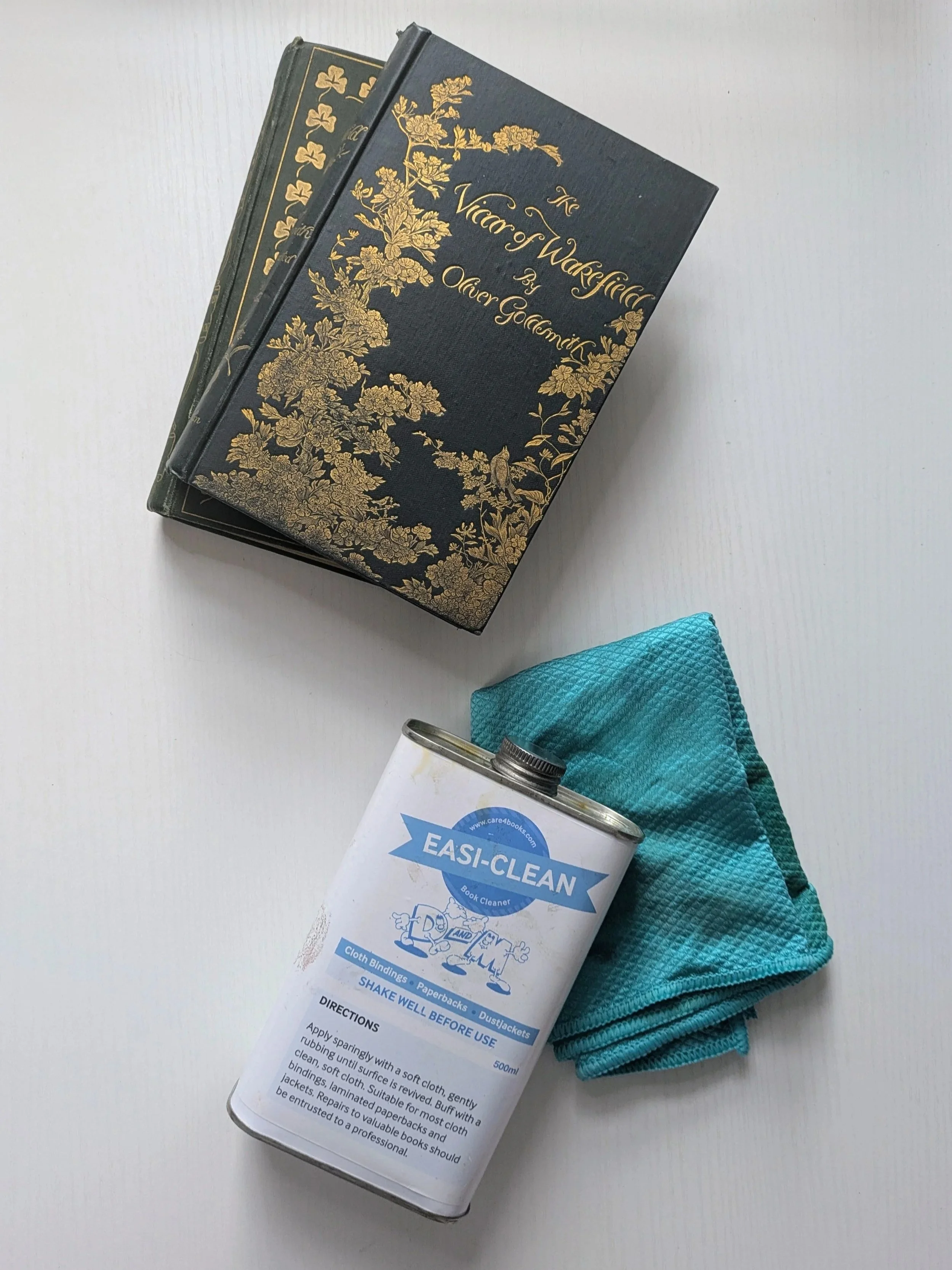
Easi-Clean Book Cleaner
What Damages Rare Books?
The main damage to rare books is from damp.
By keeping your books in a damp room, the pages buckle, and you can even cause mould to form on the dust jackets.
Rooms with rapid temperature changes will cause foxing on the pages. Foxing is the discolouration of paper caused by moisture reacting with paper additives. It looks like little brown or yellow spots on the pages.
Older books are more likely to fox, so they need more care. As such, to preserve rare books, keep them in a temperature-stable room and out of direct sunlight.
Damp Rooms – causes foxing to the paper
Direct Sunlight – causes the colour to fade
How I Look After My Books
Most books are not rare or delicate enough to need professional restoration. My book repair box contains a dust cloth, eraser rubber, PVA glue and book cleaner.
First, I dust my books with a cloth. Next, I look through the book for pencil inscriptions. Typically, another bookseller has their price in pencil that you can rub off. Make sure to do this carefully, or you will crease the papers.
Next, if the spine is slightly loose, you can repair this with PVA glue. Even professional bookbinders use PVA glue to attach spines to books. You can even glue loose pages back on with PVA.
As for cleaning books, I use Easi-Clean book cleaner. It works well on leather, vellum and plastic covers. However, on some cloth or cardboard covers, you can remove the ink. Sometimes vintage books look better even with a rough clean.
So, you start to buy rare books that are not too rare you can preserve them yourself. For more expensive books, you will need to pay for a book binder.
What’s in my book repair box
Dust Cloth
Eraser
PVA Glue
Easi-Clean book cleaner

My Book Repair Box, 2026
Restoring Rare Books
If your book is genuinely rare or valuable, look for a professional book binder with experience in antiquarian books. A good place to start is the Society of Bookbinders, which lists n professionals in the UK.
Before agreeing to any treatment, ask for photographs of similar work, a price quote, and an explanation of the restoration details.
The problem is that there are few high-quality bookbinders in the UK, and the good ones are always fully booked. I am considering taking a book-binding class to learn the basics, but even so, the profession is disappearing.
If anyone has any recommendations for book binders, please let me know below.
FAQ
Should rare books be stored upright?
Yes, store most rare books upright on shelves. Make sure there is enough room to stop them from leaning, as leaning can warp the covers. Large, heavy books are better stored flat,
Can sunlight permanently damage books?
Yes, direct sunlight can seriously damage rare books. It can cause fading, brittle paper, and weakened or discoloured bindings. Over time, UV rays speed up deterioration.
Should you wear gloves with old books?
You should generally not wear gloves when handling old or rare books. Clean, dry hands are usually safer because gloves make fragile pages harder to turn.
What is foxing in books?
Foxing in books appears as small brown, yellow, or rust-coloured spots. These are generally caused by the oxidation of iron impurities in the paper. To avoid foxing, keep books in low-humidity rooms.
Final Thoughts
Rare books can last for generations when they are stored properly. A stable temperature, low humidity, careful handling, and protection from direct sunlight all help preserve their condition. If you are starting a collection, consistent care matters far more than expensive preservation.
I am a new bookseller. If you have any advice on how to preserve rare books, let me and others know in the comments below. You can also follow my bookselling journey on Instagram @sixbookshop